
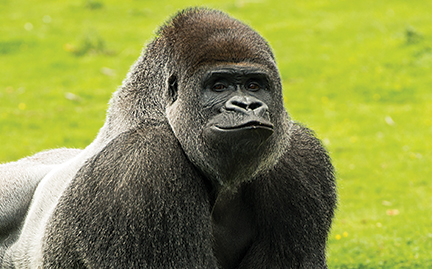
GORILLAS
Gorillas are herbivorous, predominantly ground-dwelling great apes that inhabit the tropical forests of equatorial Africa. The genus Gorilla is divided into two species: the eastern gorilla and the western gorilla, and either four or five subspecies. The DNA of gorillas is highly similar to that of humans, from 95 to 99% depending on what is included, and they are the next closest living relatives to humans after chimpanzees and bonobos. Gorillas are the largest living primates, reaching heights between 1.25 and 1.8 metres, weights between 100 and 270 kg, and arm spans up to 2.6 metres, depending on species and sex. They tend to live in troops, with the leader being called a silverback. The Eastern gorilla is distinguished from the Western by darker fur colour and some other minor morphological differences. Gorillas tend to live 35–40 years in the wild. Gorillas' natural habitats cover tropical or subtropical forest in Sub-Saharan Africa. Although their range covers a small percentage of Sub-Saharan Africa, gorillas cover a wide range of elevations. The mountain gorilla inhabits the Albertine Rift montane cloud forests of the Virunga Volcanoes, ranging in altitude from 2,200 to 4,300 metres (7,200 to 14,100 ft). Lowland gorillas live in dense forests and lowland swamps and marshes as low as sea level, with western lowland gorillas living in Central West African countries and eastern lowland gorillas living in the Democratic Republic of the Congo near its border with Rwanda.
A gorilla's day is divided between rest periods and travel or feeding periods. Diets differ between and within species. Mountain gorillas mostly eat foliage, such as leaves, stems, pith, and shoots, while fruit makes up a very small part of their diets. Mountain gorilla food is widely distributed and neither individuals nor groups have to compete with one another. Their home ranges vary from 3 to 15 km2 (1.2 to 5.8 sq mi), and their movements range around 500 m (0.31 mi) or less on an average day. Despite eating a few species in each habitat, mountain gorillas have flexible diets and can live in a variety of habitats. Gorilla foraging Eastern lowland gorillas have more diverse diets, which vary seasonally. Leaves and pith are commonly eaten, but fruits can make up as much as 25% of their diets. Since fruit is less available, lowland gorillas must travel farther each day, and their home ranges vary from 2.7 to 6.5 km2 (1.0 to 2.5 sq mi), with day ranges 154–2,280 m (0.096–1.417 mi). Eastern lowland gorillas will also eat insects, preferably ants. Western lowland gorillas depend on fruits more than the others and they are more dispersed across their range. They travel even farther than the other gorilla subspecies, at 1,105 m (0.687 mi) per day on average, and have larger home ranges of 7–14 km2 (2.7–5.4 sq mi). Western lowland gorillas have less access to terrestrial herbs, although they can access aquatic herbs in some areas. Termites and ants are also eaten. Gorillas rarely drink water "because they consume succulent vegetation that is comprised of almost half water as well as morning dew", although both mountain and lowland gorillas have been observed drinking.
WHERE WILL YOU FIND THEM
You will find the Gorilla at pen 7, in Monkey Trail.