
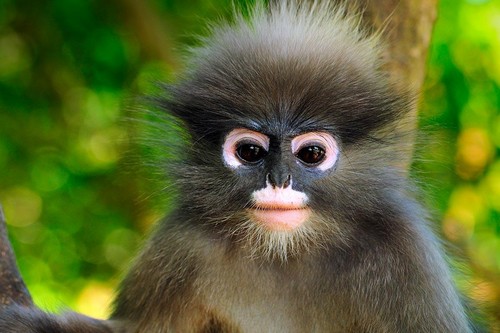
MONKEYS
Monkey is a common name that may refer to most mammals of the infraorder Simiiformes, also known as the simians. Traditionally, all animals in the group now known as simians are counted as monkeys except the apes, a grouping known as paraphyletic; however in the broader sense based on cladistics, apes (Hominoidea) are also included, making the terms monkeys and simians synonyms in regard of their scope. Monkeys are divided into the families of New World monkeys (Platyrrhini) and Old World monkeys (Cercopithecidae in the strict sense; Catarrhini in the broad sense, which again includes apes). Many monkey species are tree-dwelling (arboreal), although there are species that live primarily on the ground, such as baboons. Most species are mainly active during the day (diurnal). Monkeys are generally considered to be intelligent, especially the Old World monkeys.
As apes have emerged in the monkey group as sister of the old world monkeys, characteristics that describe monkeys are generally shared by apes as well. Williams et al outlined evolutionary features, including in stem groupings, contrasted against the other primates such as the tarsiers and the lemuriformes. Monkeys range in size from the pygmy marmoset, which can be as small as 117 millimetres (4.6 in) with a 172-millimetre (6.8 in) tail and just over 100 grams (3.5 oz) in weight, to the male mandrill, almost 1 metre (3.3 ft) long and weighing up to 36 kilograms (79 lb). Some are arboreal (living in trees) while others live on the savanna; diets differ among the various species but may contain any of the following: fruit, leaves, seeds, nuts, flowers, eggs and small animals (including insects and spiders). Some characteristics are shared among the groups; most New World monkeys have prehensile tails while Old World monkeys have non-prehensile tails or no visible tail at all. Old World monkeys have trichromatic color vision like that of humans, while New World monkeys may be trichromatic, dichromatic, or—as in the owl monkeys and greater galagos—monochromatic. Although both the New and Old World monkeys, like the apes, have forward-facing eyes, the faces of Old World and New World monkeys look very different, though again, each group shares some features such as the types of noses, cheeks and rumps.
WHERE WILL YOU FIND THEM
You will find the Monkeys at pen 11.